skip to main |
skip to sidebar
The image of moss brings a sense of calm, age, and stillness. Japanese gardens, and the Chinese before them, have long used this quality of quietude to excellent effect.
 A carpet of moss on hard porous stone is more than an brilliant image, it is the essence of coexistence: Moss thrives on materials which are porous and water retentive, such as brick, wood, and certain coarse concrete mixtures.

Above, the Karesansui garden at TMfuku-ji in Kyoto, Japan. A moss covered wall to soothe the spirit like a vertical meditation rug.
 Moss requires shade and moisture as its soft membrane and poor vascular system aren't well suited for moving water throughout the plant by itself. Without damp conditions moss desiccates quickly, especially in the sun. It will appear brown and dead but will return to green efflorescence when watered again. (Some mosses can hold up to ten times their weight in moisture after watering.) Water is also a necessary element in the reproductive cycle as it moves spores away from the plant.
 Japanese-born and Los Angeles-resident artist Mineo Muzuno created these large pebble forms dotted with holes for a moss covering that serves as a kind of organic glaze.


Moss covered bath mat by Switzerland-based designer Nguyen La Chanh. As you might suspect, the often humid and sometimes drippy conditions of the bathroom are hospitable to moss. The substrate is made from porous polyethylene Plastazote foam, used most often in prosthetics for its low skin irritation qualities.  London Artist Anna Garforth is building a poem using moss lettering (to be installed in four parts). As the moss grows the stanza will grow out of the confines of the individual letterforms as a kind of work in progress.
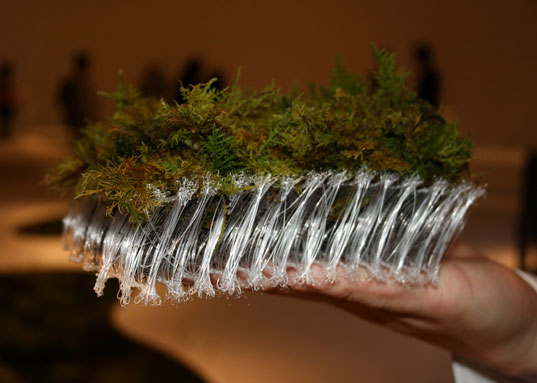
 Living moss jewelry from Icelandic designer Hafsteinn Juliusson. (Discovered at GreenMuze blog, here.) Last year's Milan Furniture Fair featured this display by Japan-based flower artist Makoto Azuma in a collaboration with Unitika Ltd.: A living indoor carpet featuring a variety of mosses.

 The moss is implanted into a receptacle made from a plant-based plastic called Terramac®. The plastic provides protection for the plant's roots and seeds as it holds the moss together. It decomposes, slowly (after ten years), into water and carbon dioxide, the latter which is captured by the plants roots through photosynthesis.
 Below, Hanging Moss Garden from the Moistscape Installation, Henry Urbach Gallery, New York NY.
Doors are more than a transition; They've become an accessory in themselves. Below, the Outline from Lualdi. Note how the door is not flush within the frame but extends beyond the plane of the wall and into the room.
The Drive from Lualdi below, a sliding door system utilizing a telescopic track installed directly on the wall. Rather than disappearing into the wall when opened, the door remains a visual feature of the room.

The Rasomuro Collection disappears, continuing the plane of the wall.
 In this interpretation, the line of the door undulates.

Above, from the Zen Collection of GD Dorigo includes laser etched graphics.Other variations of texture, color, and style:
 Again from Lualdi, the Swing Collection, using glass to create transparency, luminosity, and depth.

Below, two public gardens with grandiose ambitions: Real Mothers, both. First, Alnwick Garden of Alnwick Castle, the ancestral home of the Duke of Northumberland. Ten years ago the gardens had been left in a state of neglect. Following the death of her husband, the Duchess of Northumberland, Jane Percy, took up the cause to build a public garden to cover the 12 acres within its walls. To create a garden with funds worthy of the castle's grandeur she established the Alnwick Garden Trust. The objective was to raise the estimated budgetary requirements of £70 million ($140 million U.S.). Presently, the project stands at two-thirds completion and the Duchess continues to pursue funding for the remainder from both public and private donors. 
 The grounds are being re-imagined by Belgian garden designers Jacques and Peter Wirtz, by some accounts the modern counterpart to the designer of the gardens Versailles. Their style nods toward the classic with its use of pergolas, yew topiary, boxwood, and imposing hedges but also includes many more avante details as well. It's the most ambitious public garden created in Europe since World War II.
 Other features include this cascading serpentine hillside fountain, a rose garden of 1000 flowers, a "poison" garden with 100 varieties of toxic plants, a $7 million tree house, many suspended walkways, and a bamboo maze.
 British sculptor William Pye was commissioned to create 8 stainless steel water sculptures for the project.

 The castle of Alnwick is a celebrity in its own right: It served as a stand in for Hogwarts in the first two Harry Potter movies.
 If Alnwick represents the Mother of All Gardens for the modern era, then Chicago's Lurie Garden in Millenium Park may be the Mother of All Urban Meadows.
The overall landscape architecture was designed by Seattle based firm Gustafson Guthrie Nichol, Piet Oudolf, and Robert Israel. The garden was to serve as an homage both to the land's prarie past and the city's motto, Urbs in Horto, meaning “city in a garden.”
 Millenium Park also features some impressive architecture as well: Above, Frank Gehry; Below, Renzo Piano.
 As any garden designer knows, nature is the final arbiter. Designs on paper are experimental as all is subject to Her whims. Same here: Certain aspects of plant designer Piet Oudolf’s plan required altering to accommodate initial overzealous tree-planting. Recently, staff has done much work to remove a number of aggressive trees.
  A river of Salvia purples.
You could say Paris-based architect Patrick Nadeau infuses his designs with vitality and mean it literally. His inventive use of plant material serves as an integral part of his structural and visual vocabulary.
The material in this case is Spanish moss, often seen suspended from larger trees in the southern and tropical U.S. Otherwise known as Tillandsia usneoides, it's an epiphytic bromeliad or "air plant." This opportunistic plant has the ability to absorb it's moisture and nutritional needs from the moist air. One of the few living things that may actually enjoy the humidity. 

Outdoors, Spanish moss often provides shelter for bats, jumping spiders and all manner of unpleasant critters. Indoors, Nadeau is able to create a softening canopy that responds graphically well with light, natural and otherwise. With this, Nadeau effectively expands the interior designer's palette.
 For more on the above, check Boffi Solferino here.Nadreau also experiments other varieties of non-soil dwelling plants and other containers as well. His bold mixture of strict modern lines in his architecture and furnishings and the various flora at his disposal all merge into a kind of joyful and controlled entropy.
 Above, an undulating wall unit/bookshelf.
 A wall garden of his design for the offices of Louis Vuitton.
 A rendered view of a proposed terrace for Louis Vuitton's offices.
 In another residential interior vision, plants peer out from table tops, from a terra cotta totem, and a suspended wall screen of pots. Bits of life stand against the sterility of a white field.

In this design under construction in Sillery, France, a living roof and walls act as insulation from both the elements and sound in this hill-shaped "Wave" House. Plants have been selected for aesthetics and their natural resistance and low maintenance qualities. (This roof salad consists of a mix of grasses, leafy succulent, thymes, lavenders, and other small perennial plants.) Also included is mist irrigation and a water recuperation system.





 Posts
Posts


